On August 8, 2023, the European Commission published the amendment regulation (EU) 2023/1608 to the EU POPs Regulation (EU) 2019/1021 in its official gazette, which officially included PFHxS and its salts and related substances in the list of prohibited substances in the EU POPs Regulation. This Regulation will take effect on the 20th day after the official gazette, that is, on August 28th, 2023. So far, the list of prohibited substances in Annex I of EU POPs regulations has been officially increased from 28 to 29.
New entry in Part A of Annex I of POPs regulations.
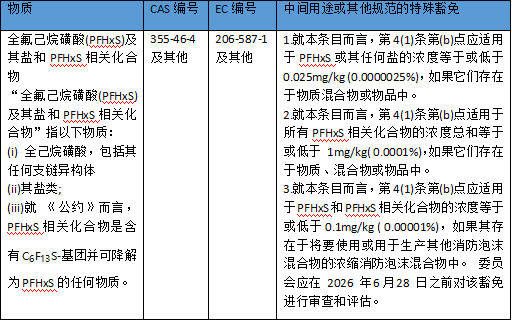
About PFHxS
PFHxS is one of perfluoro and polyfluoroalkyl compounds (PFAS), which can be used as a substitute for PFOS and PFOA, and is often used for:
1. Water-based film-forming foam (AFFF) for fire fighting.
2. Metal electroplating
3. Textiles, leather and interior decoration
4. Polishing agents and cleaning agents
5, coating, impregnation/protection (for moisture, mildew, etc.)
6, electronics and semiconductor manufacturing field
In addition, other potential use categories may include pesticides, flame retardants, paper and packaging, petroleum industry and hydraulic oil. PFHxS, its salts and PFHxS-related compounds have been used in some PFAS-based consumer goods.
About POPs regulations
POPs laws and regulations are formulated to fulfill ITU's commitments under the Stockholm Convention on Persistent Organic Pollutants and the 1979 Protocol to the Convention on Long-range Transboundary Air Pollution on Persistent Organic Pollutants. POPs is the abbreviation of Persistent Organic Pollutants, and its Chinese name is "Persistent Organic Pollutants", which means that it is highly toxic, difficult to degrade in the environment, bioaccumulable, and can be transported across borders through air, water and migratory species for a long distance and deposited in areas far away from other discharge sites, and can be accumulated in terrestrial and aquatic ecosystems. Up to now, EU POPs regulations have listed 28 prohibited and restricted substances, including 13 pesticides and many industrial chemicals.
Warm tips
The elimination and elimination of persistent organic pollutants has always been the focus of global attention, and the enforcement of such substances in the European Union is also constantly strengthening. ZRLK suggested that relevant enterprises should always pay attention to the dynamics of laws and regulations, formulate control measures for enterprises, and reduce the economic losses caused by products violating POPs laws and regulations. Our company has a wide range of testing fields and a professional and efficient service team, which can help enterprises evaluate the special chemicals regulated in products and make your products meet the corresponding national and international organization standards. If you need it, please feel free to contact us, and our engineers will serve you at the first time!